
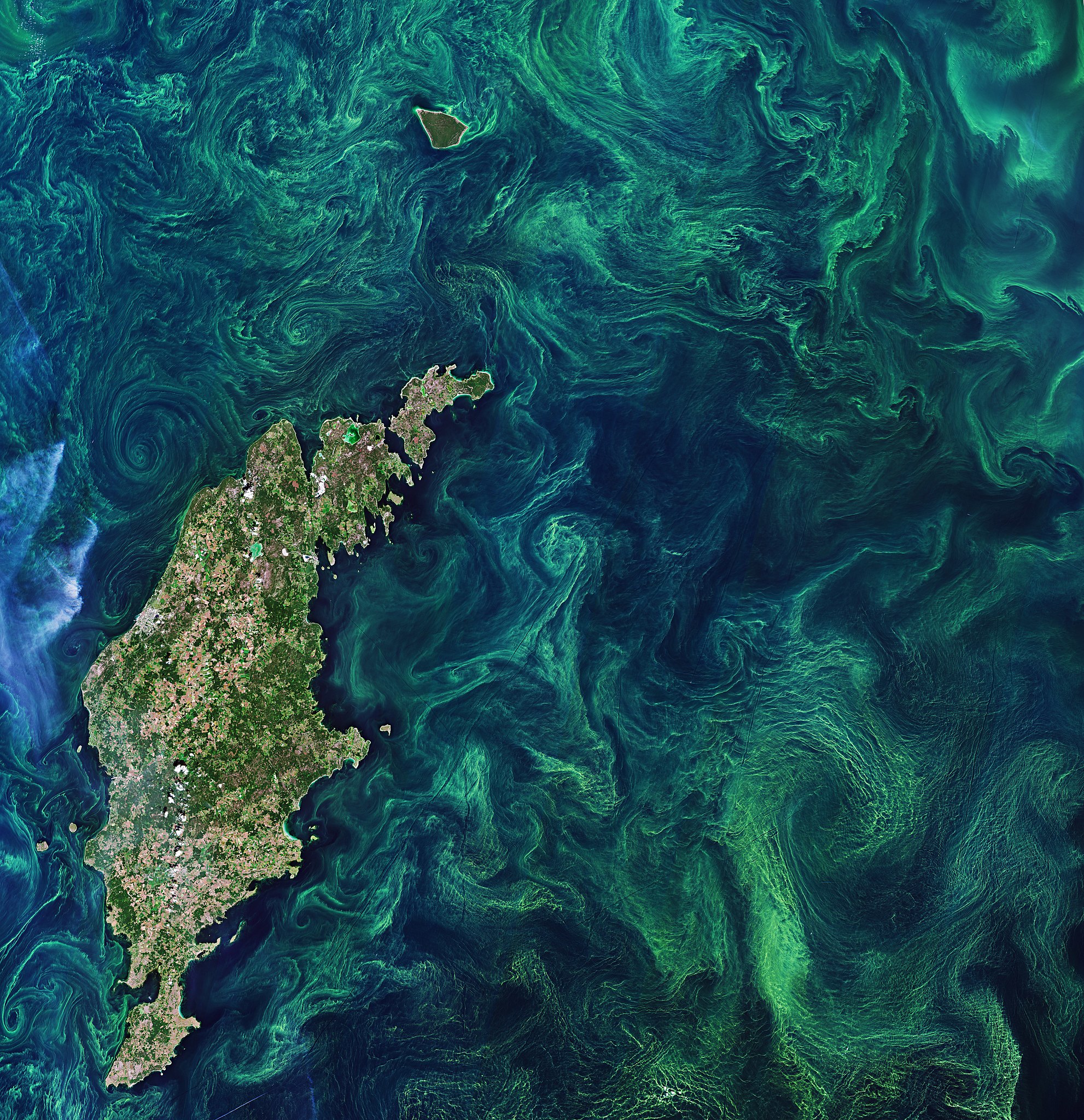
Satellite image of green algae blooms swirling around the Baltic Sea | Credit: Sentinel-2, Copernicus Programme; contains modified Copernicus Sentinel data 2019
Algae, the most ubiquitous renewable substance on Earth is considered a nuisance by most people. Yet, it may be our salvation for rising gas prices.
Algae can grow anywhere, in brackish back-waters to vast oceans. The salinity of its environment also does not hinder its proliferation. Where other creatures find ocean life inhospitable, algae thrives. Algae grows in the desert as well as it grows at the North Pole.
Algae also have the benefit of lowering the emission levels of CO2. Chlorella algae have been used experimentally in Japan to cut emissions from power stations. It uses the algae’s fixation of CO2 during the photosynthesis cycle.
In other words, just passively growing algae can garner CO2 tax credits that can, in turn, be sold to power stations to offset their own CO2 emissions.
Thus, algae is considered a carbon neutral source of fuel because of its CO2 fixation abilities.
Algae are the scavengers of the vast mires of non-potable water. Algae efficiently extract nutrients from waste water while yielding biomass ten times the rate of land plants that use up limited fresh water supplies.
One acre of corn yields only 20 gallons of fuel a year. An acre of algae can yield 3,000 to 15,000 gallons of fuel.
Presently, there are scores of companies racing to find the algae best suited for bio-fuel production. While some algae can produce up to 50% of its weight in oil, production and refining costs are prohibitive.
The Defense Department estimates that the cost of converting algae into a gallon of gasoline is twenty dollars. Costs must decrease to around two dollars a gallon to be economically viable.
The interest of algae-based fuel has spawned a mini-oil rush as academics and private companies compete to unlock the secrets of low-cost algae fuel production. The Scripps Research Institute and the University of San Diego collaborated to start Sapphire Energy Company.
Defense Advanced Research Projects Agency, (DARP) is working with Honeywell and the University of North Dakota to make jet fuels from algae. Roger Ruan\’s lab at the University of Minnesota is also active in the hunt.
Ruan has called algae a near- perfect feedstock. It can be grown anywhere. Algae can utilize sewage and take out pollutants such as phosphorous and it has a high density of oils that can be converted into diesel and its cellulosic waste products into biocrude.
Today’s corn-based ethanol has its share of critics. Ethanol is a low octane fuel. Ethanol is also slightly acidic and engines have to be modified to accommodate its corrosive actions.
Utilizing corn for biofuel has also exacted unintended consequences. Corn-based products are utilized anywhere from bread to the sweetener dextrose. Because of this, ethanol has been implicated in the rapid rise of the United State ’s core inflation since there is less availability of corn for food derivatives as demand for corn-based fuel has increased.
The United States has transformed itself from a country that once produced so much corn, and so efficiently, it had to give subsidies to farmers to support corn’s selling price. The U.S. Government, utilizing foreign food aid programs, couldn’t give corn away fast enough.
Last summer, demand for corn was so high, record prices on the Chicago Mercantile exchange caused food riots in the far reaches of the globe. The once-scorned nuisance named algae may be America ’s salvation for both its food inflation and energy woes.