
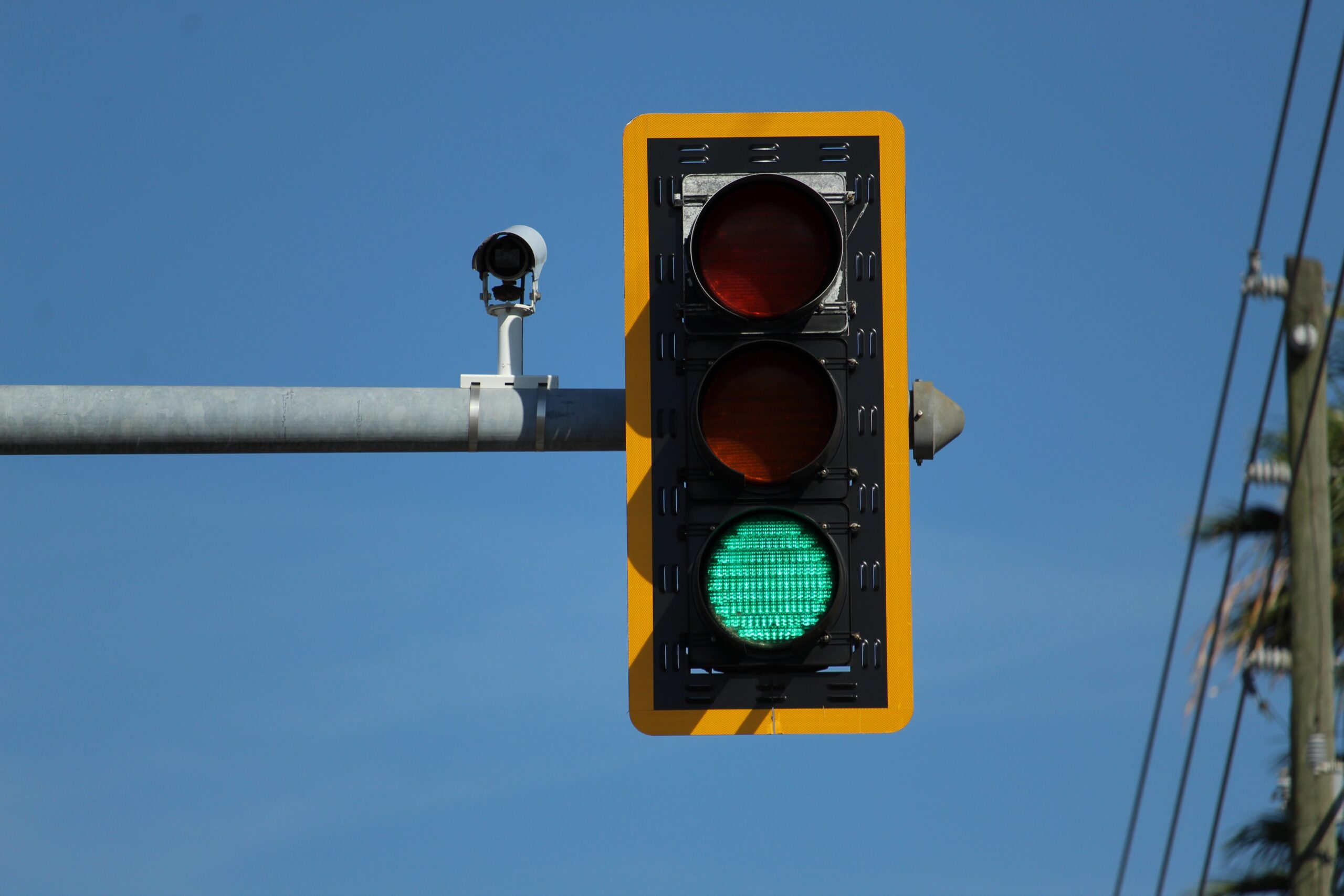
This past winter, I made a right turn on Manchester (a fairly busy thoroughfare in downtown Saint Louis) while the light was turning yellow. I stopped for a fraction of a second while calculating whether the oncoming traffic posed a threat. While underway again, I noted a flash in my rear-view mirror, and I immediately realized I might have been captured on some kind of photo-enforcement camera.
Several weeks later, my suspicions were confirmed by a mailed summons stating that my car had been videotaped making a turn on red without stopping. I logged on to the web address to view my violation multiple times using my net book computer. Since its screen was only 11 inches wide, I displayed my transgression on a forty-inch TV screen while proclaiming my innocence to my entire family.
My son rolled his eyes and said, “Right, dad” and pointed out the video displayed a smooth progression of my car making a right turn on a red light with nary a hint of a stop. Dismayed, I viewed and reviewed the video obsessively, gradually causing me to question the very memory of my momentary stop. Had my mind confabulated the stop while my car went through that right turn during a red light- albeit at a glacial pace?
After the fifteenth viewing of the 11 second clip, I noticed jaywalker transversing 4 lanes of traffic about 150 feet from my car. What caught my eye was not the fact that he was a fellow lawbreaker caught at the same moment of time; it was the manner in which he was walking.
The jaywalker seemed to move in magical irregular spurts, his body time- shifting several inches in front of him, materializing and disappearing, as if he was a victim of some malfunctioning transport machine in a low budget Star Trek episode. At that point, I knew my one-hundred dollar fine was as good as gone.
I videotaped that jaywalker, enlarged five hundred percent on my 40- inch screen. Then I researched the company that provided the photo cameras. As demonstrated by the staccato gate of the jaywalker, the video had used a proprietary video compression algorithm to save space. In other words, several frames were dropped during the eleven-second run of the video and other frames were altered by the compression software just to save space in the memory of the camera.
Not only did I find a description of the video compression software that the company produced and used with its photo enforcement cameras, I found that there were only 5 frames recorded per second of video. In contrast, a film in a movie theater uses 24 frames per second. The company used a low-tech way of compressing data- the cameras just recorded less data by capturing less real time. The compression software further compounded the loss of data by using an algorithm called (surprise, surprise) lossy compression.
Lossy compression is an algorithm that eliminates redundant information so when a file is uncompressed that redundant information is lost. However, to smooth things out, another software program called vector quantization looks at an array of data and then generalize what it sees, compressing redundant data (such as a stopped car), and while at the same time retaining the desired object- in this case, my car (which was the main object in the foreground). Then a fractal algorithm program was used to generate the sections that were lost by the compression by using similar video bit data that had been recorded.
This why the car seemed to move smoothly in the foreground, while the pedestrian in the background (not a desired object subject to a fractal algorithm reconstruction), had a disjointed time-shifting gait.
I presented this evidence in court, complete with incriminating facts from the company’s website as well as the video tape of my car and the jaywalker proving that video compression was utilized. The judge was convinced that the altered video had, in effect, lost data that could have proved my braking. The judge complemented me on my unique defense and persuasive evidence.
I was found not guilty.